

Join us as we talk to Jason and Tara Troxell of Arctic Reptile Ranch about life with Galapagos tortoises. We’ll talk about how they ended up on the islands to begin with (hint, it’s not island gigantism!) and earned the nickname “Galap-holes”. We go beyond the standard nature documentary fare to dig into what life with these magnificent animals is truly like. It’s a story that begins in an unlikely place, finding Galaps in Alaska.
Beyond their personal journey, we dive deep into the natural history of the species and exploring how humans drove giant tortoises to extinction in nearly every other part of the world. Jason and Tara also provide a sobering look at captive care, from the immense costs of veterinary treatment (sometimes the price of a car) to the reality of caring for animals you can’t physically move on your own. Whether you are a dreamer or a future keeper, this episode covers the legality, logistics, and heavy lifting required to keep these surprisingly intelligent, sensitive giants.
Auto Generated Transcript *
*may contain errors
Chapters
| 0:28 | Introduction to Galapagos Tortoises |
| 3:29 | The Troxel’s Journey into Tortoise Keeping |
| 4:03 | Natural History of Galapagos Tortoises |
| 10:48 | Human Impact and Conservation Challenges |
| 21:57 | Legalities of Keeping Galapagos Tortoises |
| 26:57 | Captive Care and Husbandry |
| 38:15 | Feeding and Nutritional Needs |
| 42:46 | Behavioral Insights and Social Dynamics |
| 52:49 | The Cost of Keeping Galapagos Tortoises |
| 1:03:34 | Reflections on Tortoise Intelligence and Care |
| 1:10:39 | Conclusion and Resources for Further Learning |
Transcript
Introduction to Galapagos Tortoises
Tara:
Today, we’re talking to Jason and Tara Troxel from Arctic Reptile Ranch about Galapagos tortoises. I’m going to let you say the species name because I’m going to mangle it.
Jason & Tara:
Oh, Chelonoidis.
Wendy:
Thank you.
Jason & Tara:
Chelonoidis and species, when we talk about natural desert, we’ll talk about whether it’s species, subspecies, and why there’s so much argument about it.
Wendy:
Okay, awesome. Welcome, and thank you both for joining me today. Can you tell me how you got started with the species?
Jason & Tara:
Well, we were in Alaska and I was looking on fauna and I found somebody in Palmer, Alaska, which is just north of where we were in Eagle River, which is a suburb of Anchorage. And they were selling Burmese star tortoises. I was like, well, crap, I would have to pay shipping. You know, back then, Burmese star tortoises were probably still about in the $1,000 range. So shipping to Alaska was usually about $150, FedEx overnight. So I’m like, ah, this is great.
Jason & Tara:
So we, you know, messaged back and forth, talked a little bit, and ended up buying the two Burmese star tortoises that were both, when they were incubated, temperature-sexed female, which that turned out great because we have babies from them. So, you know, several years later, we have babies from them. But he also, he apparently had lived down here, and some of our tortoise friends that we got to know later knew who this person was. And he had purchased Galapagos tortoises from Jerry Fyfe back in 2014. I think that was like his second or third year producing them. It was like early on when Jerry had done that. And he decided to move his collection to Alaska. He wanted to go up there. And I don’t remember what industry he was in, maybe carpentry. I can’t remember. But he just wanted to go Alaska and Hermione because there was a building boom up there. So he moved to Alaska and he had a bunch of Burmese stars. And he was selling off his tortoises because he was getting into high-end red-eared sliders. He wanted to get all the morphs and all the color things and whatnot. And we got to know him. We found out that he had a radiated tortoise and Galapagos tortoises. I’m like, no way. He’s like, yeah, you guys can see him. I’m like, whoa.
Jason & Tara:
So we bought a couple of Burmese stars from him. And then we ended up buying his radiated from him. And then when we found out that we’re definitely not going to retire in Alaska, we’re going to come down here back to Arizona. He had decided at that time that he was going to stay in Alaska. He knew that was no place for Galops. We knew that was no place for Galops. And because we were both residents of Alaska at the time, I bought them from him. He knew they needed to go back, but he wasn’t willing to just give them to me to bring back. So I still had to buy them from him. And we, that was October 31st of 2017 is when we became Galapagos owners. And we were coming back August of 2018. So it was, it was going to be just under a year up in Alaska before we came down here. And at the time I didn’t know exactly where, but my career field, there was only a few bases I could go to. And most of them were Southern bases where the climate would be favorable to these guys. And it just happened. We got lucky that Arizona was the place. And I’d already had a couple of friends down here that were tortoise keepers.
The Troxel’s Journey into Tortoise Keeping
Jason & Tara:
So it just great luck. The big air force really read my mind and got me to the place that I needed to be.
Wendy:
And a lot of luck in finding them too. What are the chances of finding Galapagos and Burmese star in Alaska?
Jason & Tara:
Very flat. Crazy. We were the only reptile people up there. Yeah. So yeah, there’s people with onesies, twosies.
Wendy:
But not big collections.
Jason & Tara:
Yeah. Not a lot of reptile keepers. There aren’t enough keepers up there to have things like reptile expos. Right.
Wendy:
Right. Yeah. That makes sense.
Natural History of Galapagos Tortoises
Wendy:
All right. Well, let’s dive into the natural history. Obviously, native ranges, the Galapagos Islands off the coast of Ecuador. They’re native to, I think, seven of the islands. Or am I off on that?
Jason & Tara:
No, you’re probably – I believe evidence in fossil, there’s nine islands where they’ve occurred.
Wendy:
Okay.
Jason & Tara:
But their only extent – they’re only living right now on seven of them. Okay. And even that, when it comes to the natural history, is here and there.
Wendy:
I noticed that while trying to research that there’s a lot of conflicting.
Jason & Tara:
Yes. Yes. So from just a pure geography standpoint, the islands that we see today are not the islands that the tortoises floated to. Most genetic studies put that at about one and a half million years ago. As far as age goes, Galapagos tortoises are kind of one of the newest kids on the block. They’re actually one of the most recently evolved tortoises. And before humans populated the West Indies over here in Florida, there were about 10 different species of giant tortoises living in the Caribbean islands. And so there was a mass radiation of giant tortoises out of South America to the various islands. And the Galapagos just happened to be the last place that people got to, which is why they’re still there. Even Florida had a giant tortoise species living in it.
Wendy:
I’ve seen the fossils. Yeah.
Jason & Tara:
Yeah. So you know that on, what’s his name? Jason Ables was using his tortoises to do a study on, on sea dispersal because in the Caribbean islands, the tortoises were all extinct before even Columbus got here. Humans, when they, like within hundreds, hundreds of years of humans arriving anywhere, tortoises tend to disappear. And those tortoises were very important for seed dispersal and like bananas, you know, bananas, they say are going extinct because there’s no, there’s no seed dispersers anymore. And tortoises were kind of the, one of the main groups of that. And that’s because giant tortoises were all over the Caribbean, Caribbean islands down into Mexico, all over there. So a lot of people know that Chaco tortoises are the closest relative of Galapagos tortoises. That doesn’t mean that Chaco’s evolved into, they just, the last common ancestor, ancestor they shared. Yeah. If you were to go and try to dig up on the islands of Galapagos, you’re not going to find a bunch of little choco tortoises and then slow evolution into giant tortoises. Getting to an island like that kind of takes being a giant to begin with. The buoyancy, the amount of fat stores to go from a mainland, you know, kind of just drift around. They can swim somewhat. You know, they’ve seen tortoises off of Al Dabra between there and Madagascar swimming along, but they’re not very good at it. So they’re not really making it there. They’re really at the whims of the currents to get where they are. And so the Galapagos Islands are between five and three million years old that they’ve been bubbling up from volcanoes and stuff.
Jason & Tara:
And about 10,000 years ago, wasn’t the biggest glacial maximum, but it was the end of the ice age. The number of islands that you would see would have been a lot less because the water level was a lot lower. So Santa Cruz and Isabella Island were one island. And a lot of the little other islands were single or part of, there’s like two or three main land masses there for a long time. Before that, I think it’s 2.6 million years ago is when the current ice age that we are in, and there’s been about 12 glacial maximums, minimums, we’re at a glacial minimum right now.
Jason & Tara:
The biggest glacial maximum, the difference in sea level, it was about 300 meters. That’s 900 and some feet. Yeah. So there was a lot more land exposed. So the kind of neat thing is the species that we see now, we’re like, well, they must have floated this island and they brought with these ones and these ones averaged off. Chances are they were on one big landmass at one point and they just those are the ones that were on higher ground as stuff as the water rose they you know migrate a little bit migrate a little bit and that’s just kind of where they ended up but at one point in time there were probably different giant tortoise species that that ended up there fossil records on galapagos very not good they’re volcanic islands so they’re made by volcano lava spewing over and making more landmass So if there’s any fossils, they’re trying to find them is kind of difficult. So what’s out in the open or in easily accessible areas is really all you’re going to get from islands like that. So just basically right now using DNA and kind of estimating when these changes occurred is the best guess and the best tool that they have to figure out when they got there, when they branched off from each other, and to what degree they’ve branched off from each other. And what’s really neat is for a while, I think there were 15, just because right now, the most recent paper says their species, I think the IUCN recognizes subspecies, will go the Marvel route and call them genetic variants.
Wendy:
Okay.
Jason & Tara:
Because they are distinct. They’re distinct enough that… The argument is, are they distinct enough to be species? Some say yes, some say no. And there were for a while 15 known. But when they sequence the DNA of the farthest east island, they sequence the DNA of that animal. It’s actually different than the animals that are currently on that island. But that was the one that the scientific name came from. So the ones on the island, while they’re still referred to by the scientific name, technically they’re a different species. So there’s actually 16 known, and I believe now that they found Ferrandina, 13 extent living still species of Galapagos.
Jason & Tara:
And, you know, you have two basic shapes. You have the dome ones, which is what we have, and then you have the saddleback. And they kind of occur in different areas. Some islands have a mixture of them, and it’s not known whether those were naturally there or the result of ships tossing them off. And they just kind of washed up and intermingled because they are using intermingled tortoises from the north of Isabel Island to kind of repopulate islands where the tortoises had been extirpated by people or the stuff that we brought to those islands. So when we didn’t directly kill them, the stuff that we did ended up killing them or making it hard for them to breed. The TTBG, the one fellow gave a talk about how there was over 100 years of no tortoises breeding because the rats would eat the babies. I’m sure they were probably eating the eggs, too, if they weren’t dug down far enough. Actually, you know, they’ve got a pretty good sniffer. But… Yeah. So those goats, goats outcompete. They eat the same stuff that the tortoises want. And so if there are babies coming up, there’s nothing for them to really eat and nowhere for them to get in and hide. Some of those islands, because they’re volcanic, are extremely rocky and there’s not a lot of places to dig. So the animals have persisted there for so long. It’s just a testament of how
Human Impact and Conservation Challenges
Jason & Tara:
tough these tortoises really can be.
Wendy:
So yeah i i read that the the population went from like an estimated 250 000 in the 16th century to 15 000 in the 70s so and they were saying that in introduced mammal species was a big part of that taking them to be like you know we don’t have to store this food type thing was a big part of it And today, the kind of tourism and development of land for agriculture is a threat as well.
Jason & Tara:
Yeah, agriculture is a problem there. There’s also a plant, it’s a type of what we consider briar. It’s a patchy thing. And it’s one of the studies that I sent over to you. It’s so pervasive and the tortoises can’t eat it, but they also can’t get through it. And it’s growing along their migratory routes. So now, even though they’ve been taking the same route for centuries, they have to find a new way to get there. And sometimes they’re not getting to where they want to be because of introduced plant species. I’ve seen on Discovery-type things that there are agreements that ranchers know not to mess with them. And if the tortoises go through, they’re going to bust their fences. But oh well, you’re going to just be fixing a fence.
Jason & Tara:
Now, that’s the official line. We know how humans really are. So some ranchers may tolerate that better than others. That’s kind of a sad fact you don’t want to think about, but that is. Another thing that was pretty big in the decimation of Galapagos tortoises, everybody talks about all the whalers and all the pirates and just the regular ships that were there in the 1800s or like 1600, 1700s. In the 1800s, when the gold rush happened in California, hundreds and thousands of tortoises were brought up the coast because that was fresh meat in California. I’ve seen menus that, you know, fresh Galapagos tortoise, tortoise soup, blah, blah, blah. So tortoises, the ones that are, that ended up probably collections up there, most of them, or not most of them, handful probably originated from them bringing those tortoises up for food in the 1850s. So that’s a little known, hey, we did it too. It wasn’t just people in the far past. It was people in our recent history that were, you know, killing these things off because we really didn’t understand what extinction was. Extinction, I’m not sure when they accepted the concept of extinction, but it was in the last century in the 1900s is when extinction was like, really like, yeah, yeah, I guess it can happen.
Wendy:
Yeah.
Jason & Tara:
So, and then when it comes to their giantness, everybody, or when I was a kid, what I learned was island gigantism. Because they’re on islands and there’s not a lot of predators, they evolved into giant sizes. In the last 20 to 30 years, that has been completely debunked. It’s not even close to the truth. Now, we’ll go back to that idea of no predators in a second, but… Around the world, in fossil records, there are more giant tortoises, we’ll say 30 inches and larger. There are more species of giant tortoises than there are current species alive of tortoises.
Jason & Tara:
My brain off the top of my head, I think if you don’t count the Galapagos as 13 species, when you just count them as like one complex, there’s like 45, 46, maybe in the 50s of tortoise species, there are more than that giant tortoises. And as Homo erectus moved out of Africa and down through Asia, and then as Homo sapiens moved throughout there, there’s a very clear record of human fossils are there, tortoise fossils go away. And giant tortoises, they’re not very fast. They’re pretty easy to catch, easy to eat, and they’re easy to make go extinct because the amount of time it takes a tortoise to become reproductive, especially the giant species, take even longer than, say, Redfoots or Burmese stars. So you take out one female and you’ve just killed 80 years of time.
Jason & Tara:
So there were, in India right now, I think is the largest giant tortoise, which about the size of a Volkswagen. I want to say its shell length was seven or eight feet long. So Galapagos tortoises now, they’re about, a big one is about four, four and a half feet. And there were even a type of turtle called Myelania, that was the genus name, that lived in New Caledonia, Lord Howe Islands down there, south of Indonesia, where Lycianus geckos come from and New Caledonia geckos. Those ones, there was one that was 200 meters long. That’s six feet long. It was a turtle with a long spiky tail and horns that it couldn’t even bring into its shell. One of them, the person that discovered it, named it Ninja Emes, which is Ninja Turtle. So it’s Ninja Emes, it’s Reeves’ eye, I think, like Reeves’ Ninja Turtle. So there were giant turtles and tortoises all over the world. And then people come along. So the only place left for giant tortoises are where people haven’t been yet. And that would be the islands.
Wendy:
Small island, yeah.
Jason & Tara:
So you got Galapagos, you have the Adabra Atoll, the Seychelles Islands, Mauritius, Reunion Island down there all off the coast of Madagascar. There were, And in the 1500s, there were six species of giant tortoises in like Mauritius, Reunion Island, that area, that within 200 years were gone once people got there. But not just from people eating them, but also from introduced cats, rats, goats, pigs, just tear up the ecosystem. So yeah, within 200 years, six species of giant tortoises that had managed to make it several hundred thousand years of human and human ancestors moving around the world and then… We kill the mountain in two centuries. There was a giant tortoise species on Madagascar. And a lot of people thought that the giant tortoise species was where the Aldabras came from. And there was a genetic study done two-ish years ago that determined that, yeah, this one is not the Aldabras. This is a completely different giant tortoise species that is related somewhat to the Aldabras, but it’s also related to the radiated tortoises. So while only sub-fossils have been found, it’s not old enough to be fossilized, mineralized, so they can still attract DNA.
Jason & Tara:
I don’t believe any of the scutes were preserved. So there’s no telling if it was just drab and bland the way our collabs on it was, or if it was striped the way a radiated tortoise. And to a smaller extent, the plowshare tortoise has kind of little radiations coming out, and spider tortoises. So yeah, the world was covered in giant tortoises for a long time. There was a species of sulcata. Sulcatas are about 20-ish million years old. There’s a species of them that was even more giant. There’s a species of leper tortoises that was even bigger than that. So even in Africa, where we have found fossils, same thing. Giant tortoises, here comes various hominids.
Wendy:
Yeah, and they disappear.
Jason & Tara:
There go the turtles and tortoises. So and that’s been kind of an understood and known thing for at least 20 years. but a lot of the literature still says island gigantism.
Wendy:
Island gigantism, yeah. Now- So, it’s not the islands making them big, it’s the pressure from the people driving them to the islands.
Jason & Tara:
Right.
Wendy:
And that’s why they end up there.
Jason & Tara:
Yeah, well, they were already in the islands. The people didn’t quite get there until later, so they persisted out there, it’s a good way of putting it. Now, what’s interesting is what’s attributed to island gigantism, the lack of predators and stuff, is probably why tortoises evolved in the first place. Because- Dinosaurs and other large reptiles and the various avian dinosaurs, very good hunters, very fast. A slow-moving, snackable thing probably wouldn’t have lasted very long. But after the meteor hit, there was a good 10 or 15 million years where most predators wiped out. Everything is starting to re-evolve and stuff. And that gave turtles time to become land turtles, not just have to swim away. And a lot of people don’t realize this, but all the sea turtles that are from the dinosaur era, those all went extinct too. So, every modern sea turtle evolved after 65 million years ago. Right.
Wendy:
They had to start again, too.
Jason & Tara:
Yeah. So, there was a second convergent evolution of these animals. And morphologically, when you look at the skeletons, they look a lot alike. Some way that that’s their thing can point out the various differences in the ancient sea turtles versus new ones. But for the most part, planogram-wise, they look basically the same. Flipper, shell, head. Yeah. Not quite a hard shell the way these freshwater and tortoises are. But yeah, they came out a second time.
Wendy:
So when they did get down to that kind of, they’re realizing, oh, hey, there’s only 15,000 of these and they’ve dropped dramatically. They did start captive breeding and hatchling release programs. Is that right?
Jason & Tara:
Yeah. The Charles Darwin Center is on Santa Cruz Island. It’s kind of the main one. There are two types of Galapagos from there. And but all of the breeding for the different islands all occurs there i think there’s another station somewhere it was in in the galapagos book that we saw the ttbgf had that for for a few years and our friend jerry fife was over yesterday and and my other friend wendy was over so we like hey jerry get this book this is it’s a great book on them there’s a handful of studies that i i sent over to you that every one of them is referenced in that book and there’s some bit of narrative in that book about what they were doing.
Jason & Tara:
And so, yeah, they started captive raising them, and they’ve had some successes, some not as much. And now we’re at a point where there are islands that are on the rebound. And what’s really interesting is if these were mammals, never could have happened. They were talking about Diego, the one, the tortoise that spent, was it 40 years at the San Diego Zoo? Yes. And another 40 years back on the island making babies. And then they released him. They repatriate him to the wild. And I’m thinking, I thought his retirement was making babies. That seems like their life. Going back to the harsh environment, I don’t dig that. I’m like, why? Just keep him there. He’s been doing good. He’s used to people. But he was the most prolific, but there were only two other males. So all of those tortoises that come from Diego or of the same species, most of them come from him, but there’s three males. So they’re all kind of unrelated. But it’s not like mammals where that small of a gene pool would-
Wendy:
Would wipe them out.
Jason & Tara:
Yeah, wipe them out or cause a lot of genetic problems.
Wendy:
Like inbreeding depression and- Yes.
Jason & Tara:
Yeah. Yeah. Now, even though they are still not dinosaurs and relatively young, they’ve still been evolving and kind of weeding out the weak ones for a lot longer. So they’ve got some really good genes working for them. So even when that’s a small gene pool, it’s still a lot better and you can repopulate an entire species from a lot fewer than if you’re trying to save tigers or something like the Caspian lion or something like that. It’s a lot easier to do it that way or a lot easier to do it with them.
Legalities of Keeping Galapagos Tortoises
Wendy:
I know there are… IUCN listed. Some of the species are extinct. Some of they’re saying vulnerable and they’ve been ESA listed since the seventies. They’re currently illegal to import. Do you know anything about the legality of keeping them in the U.S.? Are there specific states where you can’t keep them? What’s that look like?
Jason & Tara:
As of right now, other than states that don’t let you import reptiles in and out, in U.S. ARC, they always do stuff every year about trying to get rid of those laws. There’s areas that might not let you keep exotic animals or exotic turtles and tortoises, but there’s no specific laws about keeping Galapagos tortoises. Most animals that are endangered, that aren’t dangerous, like a tiger or certain bears, there really aren’t a lot of laws about keeping them. The laws revolve around commerce. So you have two things that kind of affect the US. Obviously, the ESA, the United States Endangered Species Act is one, but CITES is another one that affects all countries. CITES is a conventional international trade of endangered species.
Jason & Tara:
And that keeps – they keep good numbers, maybe. And they also regulate the movement from country to country of tortoises or all animals that are listed under CITES, which is pretty much all wildlife. Some are not allowed to be moved. And I guess sometimes zoos might be able to get permission or some institutions get CITES-1 are the most endangered animals. They’re not supposed to, there should be no commerce or no movement from country to country. EU has their own exceptions over there because the European Union, all those bunch of countries, when they became the EU, there was a lot of interesting things that happened over there to kind of make stuff uniform. I don’t live there, so I’m not an expert on that. But I’ve seen that with tortoise keepers, like they have to have certain permits and stuff. But in the United States, you can, most states, there are no prohibitions on keeping Galapagos tortoises specifically. Where the prohibitions come from, is selling them, commerce, trading them.
Jason & Tara:
If let’s say a baby Galapagos tortoise is 5,000 and three Aldabras are $5,000, I could not go to California and trade those animals because even though it’s an equal amount of money, it’s still a trade, it’s still a commerce type thing.
Wendy:
You’re getting something for it, yeah.
Jason & Tara:
Yeah, I’m getting something different. Now, if I had a male Galapagos tortoise and somebody had a female Galapagos tortoise in California, because it’s the same species, I could drive over there and we could swap them like, oh, cool. Thanks. You know?
Wendy:
Oh, I didn’t know you could do that.
Jason & Tara:
Yeah. You can trade one for one of the same species. Obviously you can’t sell them directly. So I couldn’t, you know, I couldn’t sell one of my choices.
Wendy:
No money for that. Yeah.
Jason & Tara:
Right. Now, if I decided to, like I’ve done before, well, or my, my, my work decides to tell me that I’m going to be moving, I can take all of my animals and move them to another location throughout the country because there’s no commerce involved. I own the animals. I’m going to New Mexico. I’m going to Illinois. I’m going to Montana. I’m going to, well, I don’t want to go to those places with my tortoises, but I can go to all of those places legally with my animals. So long as that state doesn’t have its own thing, like, Hey, we don’t want you bringing your tortoises here because so long as the state says you’re good, you and your tortoises can move wherever. Now you can also put them out, put them out on breeding loans. So I have 10 female Galapagos tortoises and somebody in Nevada has a male Galapagos tortoise. He can bring that tortoise down to me and they can make as many babies as they want. And that’s a breeding loan, which is also a very legal thing. You can also technically gift them to somebody. If I wanted to say, hey, happy birthday, here’s a tortoise. The problem with gifting is, is proving that it was a pure, pure gift. Right, that there was nothing in return. Yeah, you and I had some kind of business relationship where I was selling you these tortoises and you’re like, you’ve been a pretty good person to be in good prices. I’m gonna give you a Galapagos tortoise.
Wendy:
They can look at any transactions within that area and be like, hey.
Jason & Tara:
Yeah, this looks fishy. This looks fishy. So that’s where gifting gets a little bit- Complicated. Yeah, complicated. The tortoises that we have from the GTA, from the Galapagos Tortoise Alliance, those are on lifelong breeding loans. So until we decide we no longer want these animals for some reason, we are their stewards until the time ends. Now, if it turns out that all four of mine end up being male and 50 others are female, the GTA technically knows they’re going to want to move these animals around, which me, I’d be like, of course, yes, do that. Because that keeps the population alive. If I was a selfish person, I’d be like, no, no, well, it’d be too bad. It’s in the paperwork. You agree to this. They’re going to move to help the species. It’s for the species, not for the keepers. That’s the whole point of putting them in different places. Also seeing what techniques work the best or what techniques work well, because there are many different techniques.
Captive Care and Husbandry
Wendy:
So let’s get a little bit into captive care. I’m going to assume just because of their size, we’re talking about what, like 200 to 600 pounds and up, that this is not an animal for a beginner.
Jason & Tara:
No. Definitely not. So a breeding female can be in the mid-hundreds on up and females can get 300 to 400 pounds. Males can top out 600, 700, 800 pounds and they’re significantly larger. So they definitely take up a lot of space period now when it comes to actual care and stuff i’ve heard.
Wendy:
The males can be a little bit spicy.
Jason & Tara:
They can be for sure but i wouldn’t even say that it’s just the males i think i have seen female tortoises and not in galapagos tortoises but i’ve seen females also kind of engaged into it yeah yeah we don’t actually know the sex of our galapagos tortoises yet although although like i said our friend jerry fife who actually his his bread or ours are babies from the ones that he had breeding many years ago he and our friend wendy she has galapagos tortoises that are currently breeding and trying to uh to make babies they are convinced looking at some of the visual signs that they’re very likely males.
Jason & Tara:
She’d been telling me, you know, females have these little little dollopy tails little small tails and like when i look at our tortoises i compare them you know in my brain scaling it up look at the male burmese star or the male the male um indian star tortoises you know their tails are you know dramatically larger and and longer but that doesn’t happen until they become sexually mature when their man parts start growing to prepare for mating so the tail starts to extend right now the base of of my tortoise’s tails is almost as big around as it’s about half as round as their leg as the base of their thighs which apparently is is compared to a female large also because you can like another sort of telltale sign is if you can take their tail and kind of pull it it’s a little bit longer than their shell sticks out beyond their shell that’s also a good sign that it’s probably going to be a male, and i every now and then i’ll get them to elevator up so i can take a picture under their shell and, And the one that’s a little bit larger, his concavity is becoming significant. Before, like when I, again, scaling up in my head, I would take our Indian star female, look at her belly. There’s a tiny bit, there’s a little bit there, like where it’s kind of on the edges, there’s a little bit of concavity, but she’s obviously a female. And it kind of looked like that. Yesterday, when we were on there looking, we’re like, oh, no, that’s a concave plaster on for sure.
Wendy:
Yeah.
Jason & Tara:
And then the other one, Beagle, is also, his shell has kind of the same, he’s about two inches shorter, but his shell shape is also a little bit more narrow. And like a lot of tortoises, like Burmese stars, males are a little bit more narrow than the females are. So we’ve been calling them he’s forever just because, no good reason. But we’re pretty sure now, and they’re pretty sure that they are males. And they’re 11 years old and we’re still 11 years old tortoises trying to figure this out. They can become sexually active at 17-ish years, but that’s kind of on the early side. So that’s like the minimum age. And they’re just now, after a decade, a decade, they’re just now showing signs of what they might be.
Wendy:
So what’s your recommended enclosure size for, I mean, juveniles all the way up? I would hope anyone who gets a Galapagos knows you’re looking at needing a lot of space.
Jason & Tara:
Yes. Size. You know, there’s – Florida, I know, has rules when you’re keeping all reptiles. They say minimum this many times its length, this many times its width. Yeah. Once I got away from snakes and became a tortoise keeper, I was always trying to build something bigger and more spacious. So I honestly couldn’t tell you what the minimum is because I don’t build to the minimum. I want to give them space. You look at it this way. These animals live on islands that are square miles large. And they’re walking through it.
Wendy:
The whole thing.
Jason & Tara:
Some of them are migrating miles and miles every year up and then miles and miles back. So the more space you can give them, the better. Now we start off in a in a climate controlled environment with them and it’s a you know pvc cage that’s four feet by two feet so that that’s the ground area and they were born june of 24, so they’re just over a year and they’re already too big for that like that’s just their nighttime enclosure now and they they are so loud and cloppy the next step up will be a medium waterland enclosure and those are how they’re about 30 wide by 60 long so two and a half feet by five feet is that the next stage up that they can go in for a little while but but very soon they have to go into something larger and when we were in alaska ours began to outgrow that waterland tub before we moved down here so i had to get really creative and took took those uh the sleds that you use when you’re going a duck hunting or snowing, you’re going ice fishing. Yeah. They were like five feet each. I cut them so that they would fit together and bolted them together, silicone it so that water wouldn’t leak out onto our carpet and made that giant thing. I think it’s in fact, standing up in our garage and barely fits in there. So it’s eight feet by about four feet wide. And that was good to get them down here.
Wendy:
I think people, I’ve heard people say, oh, you know, I’ll get a little tiny baby Galapur Aldabra, and I’ve got plenty of time to figure out the space. You don’t, do you?
Jason & Tara:
You don’t have enough time. Five years goes by so quickly. We’ve been here for just over seven at this point. And when we first got here, Beagle and Fitz were, I don’t know, like 20 pounds or so. And i thought oh my gosh like we we have we have time right but very very soon the edge of their enclosure space outdoor enclosure space had to be expanded and then not long after that all the way to the back fence because you just so very quickly run out of time and they’re growing so rapidly i’m seeing that in some of our younger ones as well the two the yearlings yeah the yearlings are They’re obviously outgrowing the one that’s inside right now, but they’re also outgrowing our baby cages that we use for every other hatchling species. They’re just essentially rabbit cages, but they’re too big to fit through the little doorway anymore. And so now we just sort of created an extra little enclosure because we have a ton of mallow from all the flooding that’s been happening. And they are just chomping through that and it’s great because they can eat literally all day long if they want to and by the time i bring them in for the evening they are so tuckered out that it is peaceful i don’t hear no stomping no nothing so yeah that’s.
Wendy:
A that’s a good segue what are you guys feeding them mostly.
Jason & Tara:
Basically anything green that they want to eat everything anything they are amazing garbage disposals I say that in like a funny tone really but they’ll eat anything from uh from dandelion to spring mix to escrowl and endive like I said I’m using the fresh mallow right now all the ton of little grasses are popping up too I think it’s a type of rescue grass out here they’re eating that to like the ground yes mulberry leaves cactus pads we have a ton of different cactuses that have been planted since we got here and so these things are like 10 feet tall now fantastic to just like you know lop a a cactus pad off and just slice it in half and they will go through that so quickly so.
Wendy:
They are not picky.
Jason & Tara:
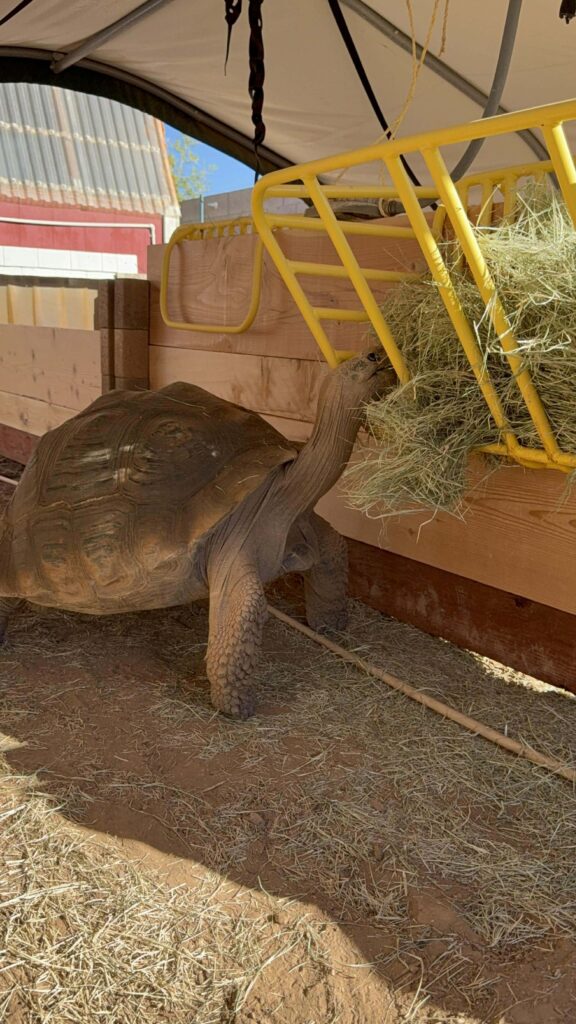
No their their staple is hay there’s always hay out there for them, Is it once or twice a week that you’re – twice a week, the small ones are getting what we call diet, which is hay pellets. Yeah. With added psyllium. Psyllium is a fiber husk.
Wendy:
Fiber. Yeah.
Jason & Tara:
A little bit of added fiber because all these human packaged foods and even some of the stuff that’s growing out there, still a little bit deficient in fiber compared to what you’ve been getting in the wild.
Wendy:
It’s pretty low fiber. Yeah.
Jason & Tara:
Yeah. If it tastes good, it probably doesn’t have a lot of fiber and it probably has more sugar than fiber.
Wendy:
Yeah.
Jason & Tara:
Um, and, and so she does that once or twice a week and they, they get that diet. It’s just, um, uh, what do you call it? It’s just horse pellets. Yeah. It looks like, uh, it looks like the zoo med tortoise diets, but just giant. Yeah. Just big squares of it. It takes an hour to soak and like fully absorb, by the way. So I start at like six o’clock in the morning. So that by the time I’m ready to go feed, it’s like mostly, mostly soft for me to work with. And when it comes to what they can’t eat, there’s not a lot. I can’t remember what island it is, but there’s an island with like little death apple is what they call it. And it’s manzanita apple or something like that. And it’s so toxic that if you touch the branches or sapkits on your skin, it’s going to burn your skin. The tortoises eat them. And no problem. They digest it. No problem.
Wendy:
Do you guys do any fruit or do you kind of stay away from that?
Jason & Tara:
Not a lot of fruit. Pumpkin, I’m not sure if it’s a vegetable or fruit. It grows on a vine. So I guess there’s- Pumpkins seasonally. Usually in October, I’ll get some pumpkin. And usually what happens is I feed them pumpkin. And then a few weeks later, we start seeing pumpkin starts popping up out of the ground. We moved a couple of them. They’re planting it for you. Yeah, yeah, yeah. We moved a couple of them. They’re seed dispersing. Yeah, exactly. Exactly. We’re hoping to get some fresh pumpkins from those. What else have we fed off to them? Honeydew. Yeah, honeydew. We had that grown once. Was it cantaloupe too? Well, it was honeydew. It was a cantaloupe.
Wendy:
Do you do any supplements at all, calcium and stuff like that?
Jason & Tara:
Yes, for the younger ones, for sure. I still use calcium powder to their food, but I also use a ton of supplements and various grasses and leaves and just flowers from Kapidolo farms okay their small cut grasses are perfect for hatchlings because it almost looks like this fine green powder so it sticks to whatever you’re using whether that’s mulberry leaf spring whatever and so they don’t.
Wendy:
Have a choice they’re eating it.
Jason & Tara:
With yeah yeah and i grow a hibiscus flowers because i love to look at them but also because they’re fantastic flowers to feed off and so every day i’ll pick a few flowers off and i’ll use that as like a topper to stuff too Yeah.
Jason & Tara:
Supplements are really good. And they do their job. But if you’re feeding a very varied diet that has plants that have a little more calcium in them, plants that have a little more phosphorus, they’re going to get a lot from the varied diet. If you’re only feeding it romaine, which a lot of people for some reason still do, only romaine, then yes, you need to add calcium. You need to supplement the crap out of that. Or if you’re only feeding them
Feeding and Nutritional Needs
Jason & Tara:
spring mix, there’s a lot of vitamins in spring mix. There’s nothing wrong with it, but it can’t be their only food. you have to give them a wide variety of plants and even some of the stuff that places will call no feeds like kale they don’t want you to feed in kale because it has a high phosphorus to calcium ratio but it has a ton of vitamins and minerals in it so if you feed something else or if you supplement a tiny bit of calcium kale is a perfectly good food it’s not a staple only food right it’s a rotate in yeah yeah it’s good if just chop up like a salad you know your salad that you that you eat it’s not just one plant it’s a handful of plants same same concept give them a wide variety and they’ll they’ll thrive they’ll grow like she said very quickly half the time when i’m going through like our vegetables at the end of the week if i have like leftover green beans or something like that that’s why i call them the garbage disposals because.
Wendy:
So these guys, as far as tortoises goes, they’re fairly expensive. So would you say they’re hard to get? Like, does it depend on you have to have a breeder of them in your state?
Jason & Tara:
You definitely have, obviously, yeah, if you’re trying to purchase one, yes, there are California, Arizona, Texas, and Florida are the only states I know of where they are in the private sector where you could purchase one from being bred at any rate. And even down here in Arizona, I don’t think Jerry’s produced any in a couple of years. The last time I remember seeing babies was 2018 or 19. Yeah, I think the last year he produced babies was probably 2018. And so, yeah, they are expensive. And you would have to live in that state, be a resident of that state to get one.
Wendy:
Yeah. I mean, it’s crazy. I went to our local exotic store just a couple of days ago, and they have like eight Galap babies in there.
Jason & Tara:
Which- Wow. Yeah. They took out a loan probably to get those. They hope to repay quickly.
Wendy:
Yeah. I’m assuming they probably got them at Daytona, because there’s just a ton down there. Right. You know?
Jason & Tara:
Yeah. And there are a handful of Galapagos. I mean, not a handful, but there’s a few that are down there in Florida. Yeah. But price-wise, for babies, you can see them for as – I’ve seen them as low as $4,000. $5,000 seems to be the price they’ve been for a long time. Now, the pet store, I’m not sure if they got a bunch of their selling at a good price or if they bought them at that price. And, like, what were they selling them for at that store?
Wendy:
I think they were $2,500 apiece.
Jason & Tara:
What? For Galapagos?
Wendy:
Yeah.
Jason & Tara:
Wow. Okay. Yeah, I mean, I haven’t bought any in a long time. So that $2,500, that’s like Aldabra. Like we used to call Aldabra’s discount collapse because, you know, they’re like one third, one quarter of the price, but they still get big and cool and they’re neat. And they’re readily available. They’re not listed on the ESA, but Galactica’s sources like we know are. So, yeah, $2,500, that is great. Relatively inexpensive i i almost want to move to florida be a.
Wendy:
Resident for a few months just.
Jason & Tara:
Moving to florida all.
Wendy:
Right genetic diversity, i’ll.
Jason & Tara:
Leave i’ll leave you out here you can take care of all the well i’m gone making my residency.
Wendy:
So normally i ask people if there’s anything about the species that would make you not recommend them i’m gonna guess if you’re not prepared for an animal of size that needs to be kept warm because you can’t just say oh dig a burrow and brumate like yeah.
Jason & Tara:
They They don’t exactly burrow the way that Sulcata is, do you?
Wendy:
Right.
Jason & Tara:
They do dig. They do move a lot of earth. Like, we have wallows out there that buffalo could get into.
Wendy:
Oh, jeez.
Jason & Tara:
Yeah, like, they’re so big, and they just move around and get comfortable. You know, we miss them in the summertime to keep them cool. That way the mud’s nice and cool, and they can get down in the mud. And when it rains, they just dig these huge wallows where just the top of their shell and their head’s showing. There’s tons of pictures of like that from the Galapagos Islands. So it’s really cool when we see them doing stuff like that. They were so happy when it flooded. That we see in books from the wild, yeah. Also, something that you may need to be prepared for is we lovingly call them galapholes because they are a-holes. They are a very, not so much territorial, they fight a lot is the only way to put it. Even the little ones will fight a lot.
Wendy:
Oh, really?
Jason & Tara:
Yeah.
Wendy:
Because I know your larger ones are kept separately, is that right?
Jason & Tara:
Yes. So, you might get two tortoises, and you’re spending five grand on two
Behavioral Insights and Social Dynamics
Jason & Tara:
tortoises, like, oh, I’ve got plenty of yard space. Do you have double that yard space? Because you may not be able to keep them together. Now, initially, I spent quite a lot on these guys. So the first time I saw them fighting when they were small, I’m like, oh my God, he’s going to bite his eyeball off. He’s going to hurt them.
Wendy:
Yeah.
Jason & Tara:
You know, there’s like 10 of these in the world. Not 10, but you know, there’s not very many in the world. We got to break them up. Right. That I think was a mistake. Yeah, it was. Because they probably would have figured it out without hurting each other too much. Now, what we saw in that one TTPG presentation, he was showing how they would, you know, one goes higher, one goes higher.
Wendy:
Yeah.
Jason & Tara:
Whoever’s the biggest, he’s the winner. And the other one wanders off. Ours never watched that talk. And they also didn’t watch the Discovery Channel where it tells you that because they bite the hell out of each other. Like one has a chip mouth because they bit each other. That’s why the walls are as high as they are. And like every couple of years, here’s an expense. You’ve got to make new walls that are higher if you don’t start off with really high walls. And wood is expensive now. Yeah, because they get bigger. Yeah. You know, not even wood. Like if you wanted to make a brick wall, well, you got to keep making that brick wall or pavers, you know, various cinder blocks. You still got to keep going up and you gotta add to it. So if you’re getting a couple Galapagos tortoises, know that they may not be able to live together. So you need twice the space. So everything we do for them, it’s double the effort.
Wendy:
And you can’t just stack cinder blocks. They’re going to knock right through that, right? So you’re doing three bar and…
Jason & Tara:
Yesterday we had a funny little thing happen. Yeah. I have some cinder blocks. I don’t remember what I use them for, but right now they’re kind of just… They’re set up in an arc and I have something on top that I can kind of sit on And when I’m out there, they’re serving no real purpose in the middle of them. So there’s a couple that are stacked too high, center blocks. In the middle, there’s like this little bit of grass, like a little bit of mallow. A tiny little piece of mallow. And Fitz honed in. Yeah, he saw the green because he was high enough and he saw it over that. And he got himself up there and top centered on that.
Wendy:
Oh, my God.
Jason & Tara:
And then he knocked the two top ones off when he was trying to spin around and turn back around and get to the food that he saw. And so like i’m trying to pull the bricks and cooks him off there he eventually climbed down but yeah they’ll go right through a brick wall that the cinder blocks that aren’t cemented down, they’re not quite to the destructive nature that you see sulcatas you know undermining foundations or busting through walls but they are as big and strong so if they want it to be, they they could definitely go through stuff like the fences we have work for them but if they were really motivated i’m pretty sure they could take out the fences that we’ve made but they have a lot of space out there and even though they’re out wandering around you know nibbling up food and stuff they’re not starving they’re not they’re not right they’re very content in in the space they have so they’re not bored they’re not yeah exactly yeah yeah so they’re not they’re not busting through those but i mean they climb they climb up on them to get to the cactus but they can be incredibly stubborn yes yes definitely very stubborn yeah so with galapagos tortoises if you’re experiencing knights that are going to be especially like young galapagos tortoises under 65.
Jason & Tara:
Get them in for sure. And at that size, you can just pick them up, right? It’s nice and easy. But when they’re a decade, 11 years old, there’s no more picking them up because those two tortoises way more than I do and I’m 120 pounds. So yeah, you just kind of have to build a relationship in order to get them to come back inside. Now, some tortoises are really, really smart and they’re going to do that on their own but the galops tend to be very stubborn and especially fits he will find his his corner because he knows exactly where the morning sun hits but if it’s dropping into the 40s at night i can’t let him stay out i just don’t want to risk that even though i know the sun is coming i’m just not that chancy thankfully the, He’s very attuned to my voice. So usually I can get him to come in that way. But if you have one that, you know, isn’t so attuned like that, you’re going to have to use some sort of other motivation method. Food works great if you can do that right now. Mallow’s working fantastic. But we used to use Missouri, the little Missouri pellets.
Wendy:
Yeah.
Jason & Tara:
We call it like the little ET method. Yeah.
Wendy:
Oh, like leaving Reese’s Pieces. Yeah, exactly.
Jason & Tara:
Yep, get them inside. she she’s not kidding when it comes to what she said about them growing fast and that it’s been more than three years since i’ve been able to lift them up to move them, yeah so when they were just over five or so about six years is probably for most tortoises growing at a decent rate about the limit of easily moving picking them up and moving them so there was a while when we would use like the rubbermaid cart and try to push them into that and cart them over and then kind of dump them out again. They were really not fans of that.
Wendy:
I’m sure.
Jason & Tara:
But yeah, like you got to find a way to move them around to go where you want them to go. And for her, that’s usually like, you know, coaxing along. I’ve seen people on YouTube and I’ve tried it too. It definitely works tapping them on the back of the show with a walking stick, you know, the rubber bottom.
Wendy:
Yeah.
Jason & Tara:
They hate that and it works, but they really don’t like it. And once they go inside, they may not come out the next day because they’re that butthurt about it. They’re very sensitive. Yes.
Wendy:
He said that they would pout.
Jason & Tara:
Yes. Yeah. Like it’s so weird how sensitive to stuff like that they can be. But I mean, realistically, you know, we’re like such a stick. For them, what was hitting me? Was it a predator? You know, is it safe to go back outside? So we look at it, butthurt, but instinctually for them, that may not be a safe thing because something was attacking them. They couldn’t, they couldn’t see it because if I, if they see me, I have to get right behind them. If they see me, they turn around and want to follow me, but they won’t follow me in.
Wendy:
Right. Of course.
Jason & Tara:
So some mystery thing was pounding on the back of them. You know, it’s a light tablet, you know, their tortoises are going to be dramatic, I guess, in their heads.
Wendy:
Yeah, their shells are sensitive and yeah.
Jason & Tara:
So to them, so it seems like not a big thing, but for them, it was like, oh my God, I almost died yesterday. I’m not going back outside. Thankfully that the tapping them method only has to be used like once or twice a year.
Wendy:
Yeah, if you can’t get them in by any other means and it’s going to be cold, like you don’t really have a choice.
Jason & Tara:
Yeah. Yes. Something else that you pick up as a tortoise keeper, and this is just in general, you’re going to learn that sunrise and sunset routine because your whole day is going to revolve around that if you’re trying to like get them in before the sun sets because after the sun sets, they’re not moving.
Wendy:
Right. It’s so much easier for us. We just check the weather. If it’s going to be below 55, we go pick everybody up and put them in. But you guys don’t have that option.
Jason & Tara:
And you don’t want to wait until- But those guys, no.
Wendy:
Yeah. Because I’m assuming when the sun goes down, they’ve powered down and they’re just not moving.
Jason & Tara:
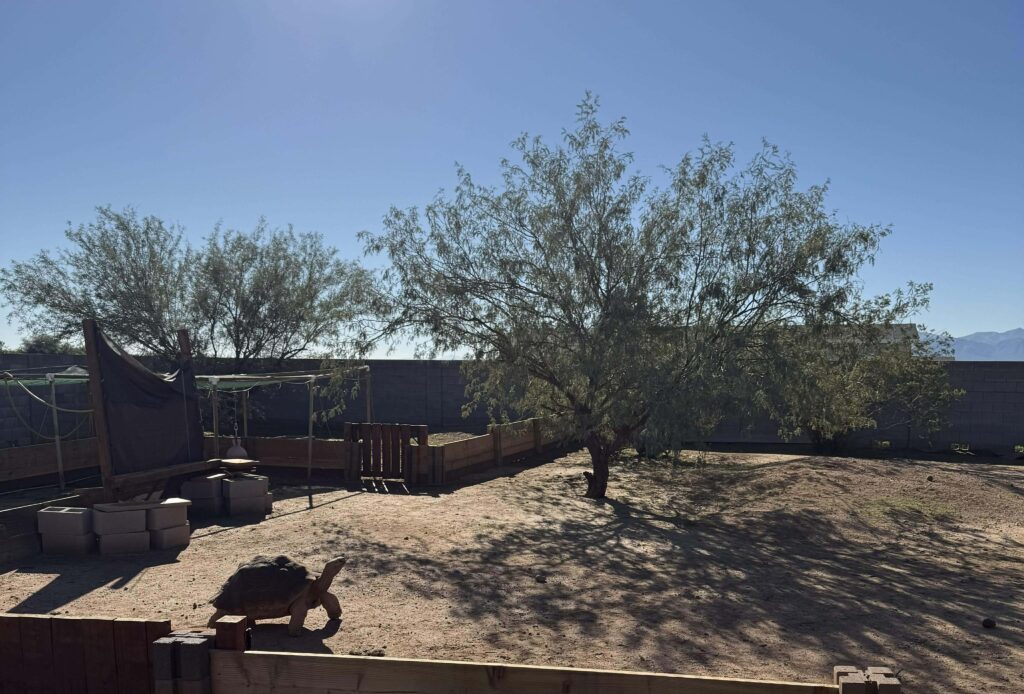
Yeah, they don’t move. Even with a flashlight, I’ve tried to put a flashlight in front of this. I think it’s daylight in front of them to get them moving. And yeah. And it can take up to an hour to get them from one side of the enclosure to the other. And our backyard’s an acre. And their area is, they’ve got about a quarter acre between the two of them. And that’s, to me, like that’s far as, about a hundred and some feet from corner, one of the corners that he likes, to the barn. Right. And we have a friend, he’s part of the UTA out in California. His live on five acres.
Wendy:
Ooh.
Jason & Tara:
And I’m like- I wouldn’t want to do that. And there’s hills involved on his property.
Wendy:
I’m like- That’s scary.
Jason & Tara:
So he knows the exact thing. But his are traveling a lot farther if that one is- And he has one. He said, she’s always at the back of the five acres. And we flip out because of what’s back. We’re like, oh my God, he’s all the way in the back corner today. I’ll take care of it.
Wendy:
Right, you got to go 100 feet. Yeah. Yeah, yeah.
Jason & Tara:
Whereas this one other person is going, you know, 250 feet times five. So they’re going several football fields to get inside. And it can be a lot. So that’s something that people need to really think about. It’s not just a giant tortoise. It needs space. You might need double the space. Yeah. Another thing people don’t think about, we’ve been very lucky that ours have not been sick. If it gets sick, you’ve got to take it to the vet. There’s not a whole lot of vets that do house calls. Some might because, you know, it’s kind of a unique thing. But so now you have a tourist that you can’t even pick up to bring inside. You’ve got to get it in the back of a vehicle and take it to a vet, get it out of the vehicle, get it seen, get it back. So that’s an aspect that a lot of people don’t really consider. And then you know as exotic vets are you know they’re going to be a little more expensive than a typical vet yeah and then there might be something very unique about what’s wrong that could become very expensive i think it was two years ago dr sam had had one that had some kind of fungal infection down in florida we saw on the camp canon youtube um he was there and and it had eaten some hay that had fungus on it or something because it had been sitting and getting wet or whatever. I don’t remember the complete story, but that animal was close to death and he had to put a feeding tube in it and he had an IV drip in it and stuff. And I think University of Florida was one that was doing the veterinary care.
Wendy:
Which is not close to him. So, yeah. Yeah.
Jason & Tara:
The number he put out, it was in the 10s, 20s, it might even have been the highest, 40 grand. I don’t remember. I just remember being, when he said the number, I was like, oh, like that’s a car. You’re paying for a vehicle for the vet care that one of these guys might need. So that aspect is something that a lot of people, when they see this really neat looking little tortoise that turns into a giant, are like, oh. And when I hear that they’re $2,500, part of the barrier to entry of keeping Galapagos was the price.
The Cost of Keeping Galapagos Tortoises
Wendy:
That’s the price. Yeah.
Jason & Tara:
Yes. So being that, I’m not going to say affordable, but relatively, that makes it- It’s scary.
Wendy:
It is. Yeah.
Jason & Tara:
Yeah. Now, from a plus side, if you are an established Galapagos keeper, that person’s probably going to need to get rid of it. And you might end up with a free one because I can’t take care of this anymore. So here you go.
Wendy:
Yeah.
Jason & Tara:
So that’s a future benefit you can’t count on, but it could happen. But wow. Yeah. There’s going to be a lot of bad decisions coming out of that pet store. That’s for sure.
Wendy:
Yeah. I would hope that they’re checking that you have enclosure and a heated shed. Because around here, it’s… They’re going to need heat at night. We do get down to freezing and yeah.
Jason & Tara:
And we get pretty cold. We get decently cold here too. And I knew that coming in. So everything that I build is insulated. I have a heater and a backup heater just in case. So short of a power outage, one of the two will work. And if there’s power, I just have a backup generator. So I’m very well prepared. I watch the Florida PetTubers all the time. And this time of year, oh my God, it’s cold. Everything’s going to die. What do I do? What did you do last year? How about the summer did you prepare did you build a better enclosure than just plywood you know i saw one you have that thing is awesome it’s thick it’s multi-layers it’s not yeah it’s got insulation yes like it’s like would you sleep in that you know would you consider that like no you need a sleeping bag if you’re in it so your animal probably needs something their version of sleeping bag insulation hey yeah and it just i know it’s good for clicks and views but it drives me crazy. It’s every year. It’s the same thing. Oh, it’s cold. They’re going to die. What do I do?
Wendy:
Right.
Jason & Tara:
I don’t know. Prepare better. Right.
Wendy:
Like before it gets cold.
Jason & Tara:
Exactly. One, it’s nice out that way you can do stuff. And if you go to zoos, unfortunately, because there aren’t a lot of, a lot of Galapagos keepers out there, there’s not a lot of people that are readily sharing information, which is something that we learned. We, we did get lucky enough to meet a couple of people that, you know, we were able to get advice and learn some, stuff from. There’s not a lot of that out there. There are some great natural history books. There’s not a lot of keeping books out there on Galapagos tortoises. So… When you go to a zoo, if you go to the zoo down here, the Wildlife World Zoo that was part of the TTPG trip, their Galapagos enclosure, they have three or four in there. It’s the size of Fitz’s enclosure. So it’s smaller than Beagle’s enclosure, which is just because of the way I build it, a little bit smaller than Fitz’s enclosure. So they have three animals in an area that I think I probably need to expand for one animal.
Wendy:
Yeah.
Jason & Tara:
And when you go to San Antonio Zoo, they have… Something that’s not even that big for their giant aldobers and their galops. The Phoenix Zoo, they have thing, like their gates are kind of cool. They’re kind of like cattle bars that the tortoises are too big to get through. But the amount of space they have is not what I would, I would never keep them in that small of a space.
Wendy:
But that’s what people have to look at, be like, oh, this is.
Jason & Tara:
Exactly. If that’s your example. And they are the most boring, dullest things you’ve ever seen. It’s just flat. No plants.
Wendy:
Yeah.
Jason & Tara:
Yeah. When our pond was built, we took the dirt and we made hills for them to climb up and down them because I knew they needed exercise. If that didn’t happen, I would have hauled dirt in here and built hills myself. There are these little balls hanging down. They’re horse balls, like these little- They’re jolly balls.
Wendy:
Yeah.
Jason & Tara:
Jolly balls. I saw, I think it’s Jason Abels was using those as enrichment. And they looked at them for the first couple of months, but they’ve been hanging there for so long. If I swapped a red one out with a blue one, that might repeat their interest and get them interested.
Wendy:
Or moved them. Yeah.
Jason & Tara:
Yeah. Yeah. I raise their feeders up really high, so they got to stretch. They got to do a little more work for it. Anything that comes in their enclosure, if I get a long log or something for a tortoise enclosure, I’ll take one, three, toss it in there just for them to give them something to look at. They’ll climb on it. They’ll look at it. They’ll sniff it. It just becomes part of it. It becomes something interesting for them.
Wendy:
It’s not just a square of dirt.
Jason & Tara:
Yes. Zoo enclosures, they’re meant to be somewhat sterile, but the ultimate purpose of a zoo is to make money. You make money by bringing people in. And if you can’t see the animals, they’re not going to come in. It’s just like Jurassic Park. There are dinosaurs on this dinosaur tour, right?
Wendy:
That’s the thing about Iguanaland that I love so much. Unless you go on the tour and they pull the animals out to show you, you are very unlikely to see them. And I love that. It’s just, you know, it’s very natural. Like they have plants to hide under. They’re underwater. They’re under roots in the water. Right. And not a lot of zoos can do that because, you know, and I know Ty has gotten that complaint before. I paid all this money and I didn’t see any of the turtles. Well, because they’re doing what turtles do. They’re hiding and yeah.
Jason & Tara:
And because you see the same thing on Facebook and turtle forums. I got a box turtle and it’s a baby and I never see it. Well, that means that’s good. That’s what it’s supposed to do. Why isn’t it coming out? Because that’s what they do. But because when you go to a pet store or a zoo, everything is right there in front of you on display. You get a really false sense of what that animal should be doing. Even if you watch nature documentaries. You know, it takes them years to get 20 minutes of footage of this animal out because they’re elusive. They do certain things in the wild.
Wendy:
If they sat out all the time in the wild, they would be gone.
Jason & Tara:
They’d be snacked. overheat, they’d be eaten, predated, something bad would happen. We have a couple of creosite bushes out there that they like to dig in and under. And I hate when they do that because that means now we got to make them back up to go forward to get in. And that is just… Basically, if they tuck their head into a corner or something, it takes a lot to get them to turn around. You basically have to make that eye contact in order to like, okay, it’s time to go do something but to get that eye contact can be challenging sometimes right and i’m trying to think some other unique things that for keepers that they just don’t know they’re they’re getting themselves into i mean realistically if you’re buying them plants or you’re growing plants yourself it’s just a little more i mean if you had say 10 or 15 redfoot tortoises you’re probably putting out a similar amount of food as you are with one or two galapagos tortoises which is still compared to 10 dogs, not a lot, you know?
Wendy:
Yeah.
Jason & Tara:
So I would say as far as food, you’re going to be using a lot more, but it’s really not the most expensive thing in the world. I don’t know. Spring mix is pretty expensive. Yeah, that’s true.
Wendy:
It is.
Jason & Tara:
They need some water that they can get up and into. You’ve seen some people, they’ll build like concrete ponds. Those work pretty well. We just let them, we just, you know, kind of like little mud things that we let puddles, you know, hose up.
Wendy:
Like a little wallow.
Jason & Tara:
Yeah, a little wallow. So they need that space. And if you’re keeping them inside, that’s where, or you have an indoor thing, that’s where it can get kind of expensive because your utility bills. Heating their enclosure, or if they’re using it in the summertime too, cooling their enclosure, it’s kind of either end of the spectrum where you’re still using a lot of electricity to get the temperature you want. And you’ve been out here and you’ve seen the evolution of my building methods, Tall building with PVC sides that work great, but they also let heat come out in the wintertime, so that wasn’t great. So then a regular shed, well, now there’s still a lot of headspace that I’m heating for no reason.
Wendy:
You’re heating all that above that.
Jason & Tara:
Yeah, exactly. So then I have something a little bit lower. So the next evolution of that will be similar to the one where the leopard tortoises and the small galopsinol divers work.
Wendy:
Something that you can just lift a lid.
Jason & Tara:
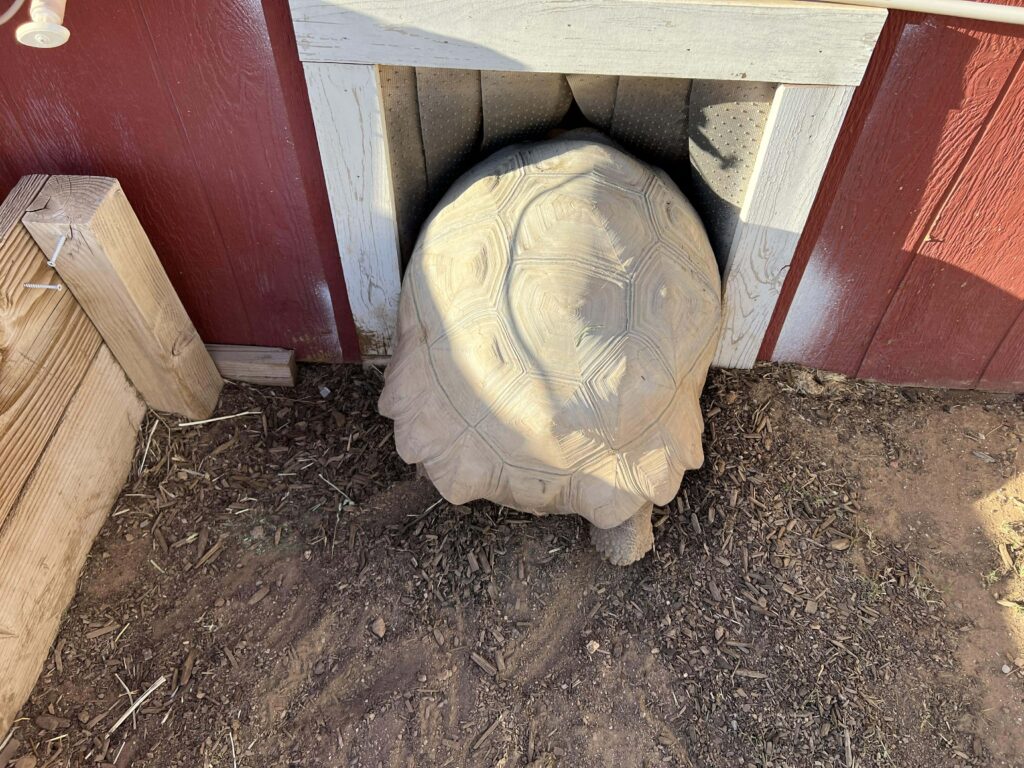
Yeah, but just larger for the giants. And she mentioned, you know, they grew fast. So two or three years ago, maybe three years ago now, I had to redo some stuff on the side of the barn I built for them. Right. Because they were getting so big, the bottoms of their shells were scraping the wood frame for the doors. And you could hear it. Yeah, I was like.
Wendy:
Oh, jeez.
Jason & Tara:
So, and to make the doors large enough, I had to take out two of the vertical beams. And really, like, I thought, oh, I get this done like a couple hours. It turned into a two weekend project doing one at a time. I had to take the wall that I built off, pull the studs, but find a way, well, how am I going to get this to stay up if these studs come out? So then I had to like brace it here. And it just turned into such a bigger project than I imagined. And that was me thinking, you know, I’ve got plenty of years. And honestly, I think they’re ready for a new building. I kind of expected the one that I built as a first structure that size I ever built my life. I really didn’t expect it to last this long. I was kind of looking kind of like a five-year plan for that particular building, but it’s been working good. It’s just, I did a surprisingly good job on that first time I built something. So, really, next summer project or next spring project will probably be the beginnings of their new building.
Wendy:
Their new house.
Jason & Tara:
So, that’s something.
Wendy:
And you do have them completely separated. It’s not like you’re just like, hey, you guys go together for the nighttime for heat.
Jason & Tara:
Yes.
Wendy:
So, people should keep that in mind too.
Jason & Tara:
They have their own stalls. Just like a horse, they have their own stalls inside the barn. And that’s another thing. What are you going to heat them in? We’ve seen some people down here keep them in – You know, we have a Rubbermaid little mini shed that we use for our hay. A person that we know, they use that to heat their tortoises. There’s like four heat lamps in there, and that’s where their tortoises go in and out of that night. It’s adequate, it works, but that’s definitely not the style that we’re used to. So understand expense-wise, you’re going to be building a small building for them. Yes. Or the biggest doghouse you can imagine you’re going to be building for them. So it’s not just the food, not electricity. see, well, now you’re looking at materials to build stuff for them, assuming you have a fenced-in backyard. One thing that is another thing to think about is they are rare, they are expensive, so you need to keep your area locked up because people want stuff. It was a few years ago, we’ve talked about it a couple times, Jerry, his place got robbed and they tried to steal his tortoises and they ran one of them over and ended up killing her.
Wendy:
I remember that. Yeah.
Jason & Tara:
And so he’s had a few robberies at his place because, you know.
Wendy:
People think they can make a quick buck by grabbing some animals.
Jason & Tara:
Yeah, they obviously don’t understand the laws. Right. Or how heavy a giant tortoise is.
Wendy:
Yeah.
Jason & Tara:
And things go sideways. And his is like, it’s one of the worst stories. And like, I don’t even like to think about it because of the damage I was done to that animal. It definitely messed up my sleep and stuff for a long time. Like, I would wake up in the middle of the night.
Wendy:
Probably your feeling of safety.
Jason & Tara:
Yeah. and think, oh my God, I need to check on everybody even though I know everybody’s safe. We have cameras and stuff, but I needed to, yeah.
Reflections on Tortoise Intelligence and Care
Jason & Tara:
So when it comes to those existential crises that people have, when we were still in Alaska and we were understanding how…
Jason & Tara:
These tortoises, individual behaviors, people call them personalities, shore personalities, how unique they are compared to a lot of our other tortoises, how quickly they become acclimated or even, you know, human associated, how quickly they see owners as part of their herd. Um it was really surprising and like i actually talked to her about it i had problems sleeping because i i had to think about those whalers and those ship people that took these same tortoises these tortoises aren’t stupid animals you know they look all big dumb silly tortoise they’re not dumb at all they’re they’re irritatingly smart and stubborn i compare them to great danes because great danes are big goofy dogs a dog that we’ve had since we’ve been married they’re big goofy dogs. They’re kind of dopey. They don’t know their size. Yeah, but they’re also weirdly smart. Tortoises are the exact same. They’re, I mean, they’re not doing algebra.
Jason & Tara:
On animal scale they’re very smart animals and i sat there and thought like oh my god these whalers were were you know these tortoises being taken maybe they might have been feeding them a little bit because it was fun for them and then whack heck and to kill a tortoise it’s not easy we don’t need to get into that so yeah we won’t get into like like my brain and my imagination just like went through the entire thing and i’m like this is absolutely horrible how could people do this how you know obviously if i put myself in the whaling if i was a on a ship situation a bit different but like that point where i was like i just flipped out for like i couldn’t sleep for a couple days because i was my brain was like that focus on these animals are so incredible they’re so just amazing and this is what people were doing to them how yeah they’re easy to.
Wendy:
Form a relationship with.
Jason & Tara:
Yes definitely yeah yeah they have some interesting articulation in their neck that a lot of other tortoises don’t most tortoises where where the atlas connects to the skull, it has some movement but they can almost do a complete 90 degree periscope kind of the way box turtles can but box turtles head a little bit longer relative to their neck size so I can’t think of any of our other tortoises that even come close to the level of an upwards periscope like this almost like a cobra without the hood can do and then they do something else that we call elevator some people call finching, where the head goes straight up They stand up big and tall and straight. I dislike calling it finching because pretty much every species of Galapagos tortoise will do that. There’s only three islands that have that type of finch that pigs that eats bugs. Most of the finches are seeded and eaters on the Galapagos. So- And obviously, this was a behavior that the tortoises were already doing that the finches took advantage of because aldobras do it, radiated tortoises do it. And there is no symbiotic relationship between finches and other animals with those tortoises.
Jason & Tara:
And if they were still around, I’m sure a lot of other giant tortoises would do it. Now, it’s a response like when it rains, they do that. So that could be some kind of response to not drowning. Because if you’re down close to the ground when it floods, you’re the first thing that floods unless you stand up. Just tapping them on their shells does it. Like there’s various things that get them to do it. Sometimes when you walk close to them. Sometimes just looking at them.
Jason & Tara:
So we call it elevatoring. Amber Rodriguez and ours, they call it hydraulics, which, you know, it kind of looks like a, you know, a low rider car going up and down.
Wendy:
Yeah.
Jason & Tara:
I really like, you know, if I’d thought of that, I’m like, man, that’s like really good. But we’ve been calling it elevator so long. I don’t want to switch only because we’ve been calling it that for so long. But I really like the idea of hydraulics because it looks like that. So I really am not a fan of the term finching. It’s the same thing. We know what it means. Yeah. It’s kind of like people saying the word creep. I don’t like using that either. Creep is a culinary term for how much tortoise meat or turtle meat you’re using. It’s so many bushels.
Wendy:
Are you serious?
Jason & Tara:
Yes.
Jason & Tara:
So many bushels is a creep.
Wendy:
Well, now I’ve got to stop using it.
Wendy:
That’s great.
Jason & Tara:
I just thought it was a song. No, no. Oh my gosh, no. Yeah. Because I never heard that in my entire life.
Wendy:
So what do we call them? A herd?
Jason & Tara:
Yeah, just call them a herd.
Wendy:
Okay.
Jason & Tara:
I never heard that in my entire life. And I’ve been a reptile person reading books and stuff forever. I’m like, where the hell did this term creep come from? So I looked up the etymology of it and yeah, it’s a culinary term.
Wendy:
Oh no, now it’s ruined.
Jason & Tara:
So when they were, you know, wholesale slaughtering diamondback terrapins in Northeast.
Wendy:
Yeah.
Jason & Tara:
You had this many creeps of turtle meat.
Wendy:
Oh, gross.
Jason & Tara:
Yes, exactly. So that’s why- I thought it was something cute.
Wendy:
But that is not.
Jason & Tara:
No, no, no, no, culinary. Yep. Yep. That’d be like, you know, how many steaks do I have running through here? No, they’re cows, you know.
Wendy:
Yeah.
Jason & Tara:
Or look at all those briskets.
Wendy:
So I think we’ve covered everything today. If anyone wants further information or has questions for you, where’s the best place to reach you?
Jason & Tara:
Instagram, probably. I’m decently responsive on there. I’m an adult, so social media isn’t the most important thing in my life. But I still, I like to talk to people and usually around to help. So the Arctic Reptile Ranch underscore between every word.
Wendy:
Okay. And I’ll put a link in the show notes in case people are looking for you.
Jason & Tara:
I have a YouTube channel that I was making a lot of content when I was in Alaska, decent when I first got down here, but then it just, it’s not a thing, just kind of went by the wayside because doing what we do out here takes more time and stuff that I just don’t have the bandwidth when I come inside between working, doing that, her out here doing this stuff.
Wendy:
And the animal care.
Jason & Tara:
Exactly.
Wendy:
Yeah.
Jason & Tara:
Yeah. I focus more on caring for my animals than telling people about that I’m caring for my animals.
Wendy:
Yeah, I get it.
Jason & Tara:
And usually when we get something out, like I’m the video editor, so it’s on me to get all the footage together. And it just takes time.
Wendy:
It does. It takes a lot of time.
Jason & Tara:
I have no less than 12 or 15 folders of footage from various things I thought might be interesting to make YouTube videos and have scripts written up. I’ve been trying since we were at the five-year mark of Keeping Up Galapagos Tortoises to make a video about Galapagos Tortoises. My script, every time I do a new one, I’ll put like a new date on it so I know which one’s the most current one. Yeah. And the reason I want to do that is because when you watch a documentary, it’s always the same thing. These giant tortoises are all majestic. They’re living. And then it shows them doing the neck raising thing, walking up the islands. And then a boy meets a girl tortoise. They make up baby tortoises. And they might show one coming out of the ground or hatching out of its egg. And the circle of life continues. What about all the time in between?
Wendy:
Yeah. What are they doing? Yeah.
Jason & Tara:
Yeah. Like how do you care for them? How do you keep them? So like, I have honestly been trying to make this video and I have, we shot video. There was one day that the jets were flying continuously. It was driving me nuts because I’m out there with the tortoises and I’m trying to talk and like, remember what I want to say is hard enough with the jets. So I have, I have so much footage and stuff of things and it’s just, you know, I shoot it and we just don’t get it back around to it. And now this, I’ve been trying to do that since we had them for like four years, five years. and like, I’ve got to change the script, you know, having kept them for this long, this is what we’ve learned.
Wendy:
You’ve changed your, yeah.
Conclusion and Resources for Further Learning
Jason & Tara:
Yeah.
Wendy:
So you get to save it for a retirement project.
Jason & Tara:
Exactly. So doing this podcast is actually a great way to kind of give people a heads up. Like, Hey, there’s, there’s there, there, yes, there are just tortoises that get really big, but there are some unique aspects of them getting big.
Wendy:
Some nuances and yeah, definitely. And I appreciate you guys sharing that with me today.
Jason & Tara:
Yeah. If people want to know more, just hit me up on Instagram, send me a message. I’ll see it eventually because, you know, that little, little thing. My Instagram is open. So, you know, a lot of people, like you have to follow them to see their pictures. Again, I’m an adult. I don’t care about followers or anything. Just go to my Instagram, look at my animals, ask me questions, leave a comment. If you like them, like them. There’s like two pictures of me on my entire Instagram because I don’t, I care that little. I just want people to see the animals. And if they have questions, then message me.
Wendy:
All right. Great. Thank you, Jesus and Tara, so much for joining me today. I actually learned a lot. I really appreciate you guys taking the time.
Jason & Tara:
Thank you for inviting us on. Yes, definitely appreciate coming on here to share. That’s something I’ve been trying to do, like I said, for many years. You know, tell people what happens in those middle years.
Wendy:
Yeah, awesome. Thank you.
References
Gaughran, S. J., Gray, R., Ochoa, A., Jones, M., Fusco, N., Miller, J. M., Poulakakis, N., de Queiroz, K., Caccone, A., & Jensen, E. L. (2024). Whole-genome sequencing confirms multiple species of Galapagos giant tortoises. Evolution, Volume 79, Issue 2, February 2025, Pages 296–308
Gibbs, J. P., Cayot, L. J., & Tapia A, W. (2020). Galapagos Giant Tortoises (Biodiversity of the World: Conservation from Genes to Landscapes). Academic Press.
Kehlmaier, C., Barlow, A., Hastings, A. K., Vamberger, M., Paijmans, J. L., Steadman, D. W., Albury, N. A., Franz, R., Hofreiter, M., & Fritz, U. (2017). Tropical ancient DNA reveals relationships of the extinct Bahamian giant tortoise Chelonoidis alburyorum. Proceedings of the Royal Society B 284: 20162235
Lichtig, A. & Lucas, S. (2015). Turtles of the lower Eocene San Jose formation, San Juan basin, New Mexico. New Mexico Museum of Natural History Bulletin. 161.
Orenstein, R.(2012). Turtles, Tortoises and Terrapins: A Natural History. Firefly Books
Rhodin, A., Thomson, S., Georgalis, G., . Hans-Volker, K., Danilov, I., Takahashi, A., de la Fuente, M., Bourque, J., Delfino, M., Bour, R., Iverson, J., Shaffer, H.B., & van Dijk, P. P. (2015). Turtles and Tortoises of the World During the Rise and Global Spread of Humanity: First Checklist and Review of Extinct Pleistocene and Holocene Chelonians. Chelonian Research Monographs. 5. 1-66.
Sadeghayobi, E., Blake, S., Wikelski, M., Gibbs, J., Mackie, R., & Cabrera, F.. (2011). Digesta retention time in the Galapagos tortoise (Chelonoidis nigra). Comparative Biochemistry and Physiology. Part A. 160. 493-7.
Vlachos, E, and Rabi, M. (2018). Total Evidence Analysis and Body Size Evolution of Extant and Extinct Tortoises (Testudines: Cryptodira: Pan-Testudinidae). Cladistics 34(6): 652–683.
Wiesner, C, & Iben, C. (2003). Influence of environmental humidity and dietry protein on pyramidal growth of carapaces in African spurred tortoises (Geochelone Sulcata). Journal of Animal Physiology and Animal Nutrition. 87. 66-74.
1 thought on “Galapagos Tortoises: Living with Giants”